Yes, cologne can expire, but not in the same way food does.
A bottle of cologne does not suddenly become unusable because it reaches an expire date. Fragrance usually changes gradually. Heat, sunlight, oxygen, temperature changes and the formula itself can all affect how a fragrance smells and looks over time.
That is why an old bottle is not automatically a bad bottle.
If you found a cologne at the back of your wardrobe that you bought years ago, there is no need to throw it away simply because you cannot remember when you opened it. The better question is whether the fragrance still smells, looks and performs as it should.
In this guide, we will explain how long cologne can last, whether unopened cologne expires, how to tell when a fragrance has gone bad, whether a 10-year-old perfume can still be good, and how to store perfume properly.
Table of Contents
Quick answer: Does cologne expire?
Yes, cologne can gradually deteriorate, but there is no single expiration period that applies to every fragrance.
The shelf life of a fragrance depends on several things, including its formulation, packaging, how often it is opened and how it has been stored.
Heat, direct sunlight and prolonged exposure to air can contribute to changes in a fragrance. A bottle kept in a cool, dark and stable place can remain enjoyable for many years.
The U.S. Food and Drug Administration also explains that cosmetic shelf life varies depending on the product, how it is used and how it is stored. It does not require cosmetic products to have one universal expiration date.
| Question | Short answer |
| Does cologne expire? | Yes, it can gradually deteriorate. |
| How long does cologne last? | Often several years, but there is no universal lifespan. |
| Does unopened cologne expire? | It can, although unopened bottles have had less exposure to air. |
| Can a 10-year-old cologne still be good? | Yes, if it was stored well and still smells and looks normal. |
| What damages cologne fastest? | Heat, light and unnecessary air exposure are major concerns. |
| How do you know cologne has gone bad? | Look for major changes in smell, appearance and, in some cases, performance. |
How long does cologne last?
There is no scientifically reliable number that says every bottle of cologne will remain good for exactly three, five or ten years.
You will often see fragrance websites mention a three-to-five-year period as a general guide, but that should not be treated as an expiration date.
Two bottles of the same fragrance can age differently.
For example, imagine you have a five-year-old bottle that has spent most of its life in a dark wardrobe. It still smells familiar and the liquid looks normal.
Now compare that with a two-year-old bottle that has been left inside a hot car, exposed to high temperatures again and again.
The older bottle may be in better condition.
That is why age is only one part of the picture.
The FDA similarly notes that cosmetic products can deteriorate at different rates depending on their formulation, use and storage conditions.
Opened vs. unopened cologne
An unopened bottle generally has had less contact with air than one that has been sprayed regularly. That can help preserve the fragrance, but it does not make an unopened bottle immune to aging.
An unopened bottle sitting beside a sunny window for years can be exposed to more heat and light than an opened bottle kept inside a dark wardrobe.
Once you open and spray a fragrance, air can occupy the space left behind by the liquid. Over a long period, oxygen can contribute to oxidation of some fragrance materials.
This does not happen at exactly the same rate in every fragrance because formulas are different.
What makes cologne go bad?
Fragrance deterioration can happen for several reasons. The main ones are:
- Heat
- Direct sunlight
- Oxygen
- Temperature fluctuations
- The fragrance formula
- Bottle and packaging
- How the bottle is used
Let’s look at each one.
1. Heat
Heat is one of the biggest things to avoid when storing perfume.
Higher temperatures can speed up chemical changes and can also increase the evaporation of volatile components. This is one reason leaving a bottle of perfume inside a parked car is a bad idea.
A car can become extremely hot, especially when it is parked in direct sunlight.
The same applies to storing fragrance beside a generator, cooker, radiator, or another strong source of heat.
You also do not need to keep your perfume in a refrigerator just because you live somewhere warm. For everyday storage, a cool, dark and reasonably stable place is usually much more practical.
The FDA specifically advises consumers to avoid storing cosmetics where they are exposed to heat, including hot cars.
2. Direct sunlight
Light can also affect fragrance over time. A bottle displayed on a shelf beside a sunny window may look attractive, but it is not the best environment for long-term storage.
If you want your fragrance to remain in good condition for as long as possible, a drawer, cupboard or wardrobe is a better choice.
Also, keeping the bottle inside its original box can provide another layer of protection from light.
3. Oxygen
Every time you spray a perfume, some liquid leaves the bottle and air takes up space inside it.
Over time, oxygen can contribute to oxidation of susceptible fragrance materials.
This is one reason an older perfume may eventually smell different from how you remember it.
However, oxidation does not affect every fragrance in exactly the same way. The formula, bottle design and storage conditions all matter.
4. Temperature changes
It is not only extreme heat that matters.
Repeated changes between hot and cool conditions are also not ideal for long-term storage.
For example, moving a bottle between a very hot room, an air-conditioned room and another hot environment every day is less desirable than keeping it somewhere with a relatively stable temperature.
The most important thing for you to do is to avoid unnecessary extremes and large temperature swings.
5. The fragrance formula
Every perfume is made from a particular combination of aromatic materials.
Some materials are more volatile than others, and different formulas can therefore change in different ways as they age.
Citrus materials such as lemon, bergamot and grapefruit are commonly used in fresh openings and can be noticeable early in a fragrance’s development.
Woody, musky, amber and resinous materials often play a bigger role in the later stages of a fragrance.
However, it would be wrong to say that one fragrance family automatically has a certain shelf life.
A citrus fragrance is not guaranteed to expire quickly, just as a woody perfume is not guaranteed to remain unchanged for decades.
The complete formula and storage conditions matter more than simply looking at the notes listed on the bottle.
If you want to understand how top, heart and base notes work, see our guide to what perfume notes are.
6. The bottle and packaging
The bottle is part of the storage system. A properly sealed atomizer helps limit unnecessary air exposure. A damaged cap, loose sprayer or leaking bottle deserves attention.
The original box can also help protect the liquid from light as I stated earlier.
If you have an expensive fragrance that you plan to keep for many years, there is little reason to throw away the box.
7. How often you use the bottle
An almost-full bottle and a nearly empty bottle have different amounts of air in the space above the liquid.
As a bottle gets emptier, there is more air inside the bottle relative to the amount of fragrance remaining.
That does not mean you should stop using your perfume just to preserve it. Perfume is meant to be enjoyed.
It simply means that good storage becomes more useful when you plan to keep a bottle for a long time.
7 signs your cologne has gone bad
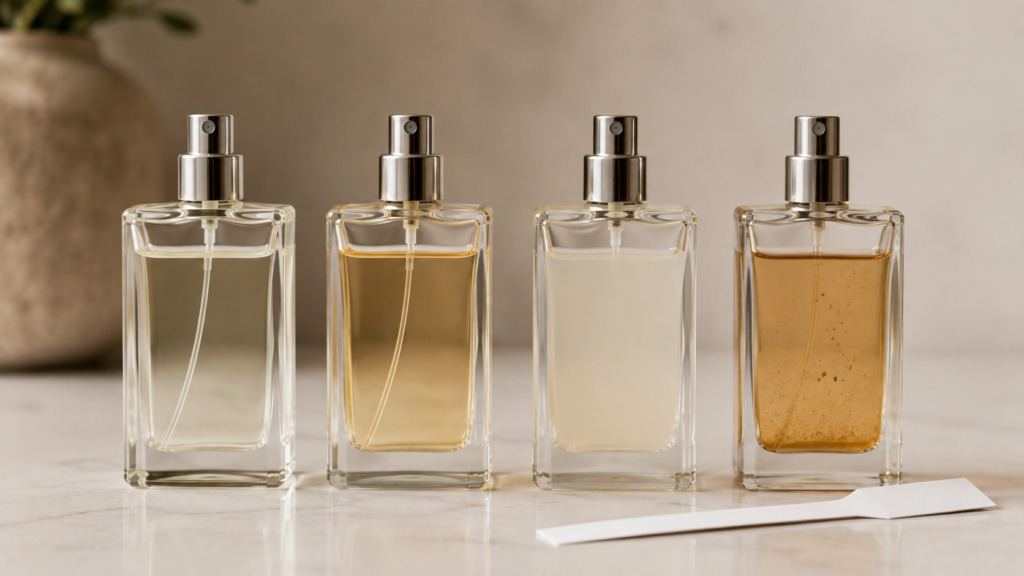
If you have an old bottle and are not sure whether it is still good, start with the fragrance itself.
1. The smell has changed significantly
This is usually the biggest warning sign.
If your cologne used to smell fresh, smooth and balanced but now smells sour, stale, metallic or completely unfamiliar, it may have deteriorated.
A small change is not necessarily a problem. Fragrances can change gradually with age, and your own sense of smell can also change.
What matters is a noticeable change that makes the fragrance smell clearly wrong compared with what you remember.
2. It smells sour or vinegar-like
A sharp sour or vinegar-like smell can be a warning sign in an old fragrance.
Do not judge a freshly sprayed perfume too quickly, though. The first moments can have a strong alcohol smell. Give it a little time to settle.
If the harsh or sour smell remains and the fragrance never develops into its familiar character, the bottle may have changed significantly.
3. The liquid has become much darker
A darker perfume does not automatically mean it has expired.
Some fragrances naturally become darker as they age because of the ingredients in the formula.
The important thing is to look at the whole picture.
Slightly darker + smells normal + remains clear: not necessarily a problem.
However,
Much darker + strange smell + cloudiness or sediment: much more concerning.
Color alone is not enough to decide whether a perfume has gone bad.
4. The liquid is cloudy
If a fragrance that was originally clear becomes unusually cloudy, pay attention.
Cloudiness can indicate that the composition has changed physically.
If you also see particles, sediment or separation, it is better to avoid applying the fragrance to your skin.
5. You see particles or sediment
Unexpected particles floating inside a perfume bottle are another warning sign.
Do not simply shake the bottle and assume everything is fine.
If the fragrance has changed dramatically in appearance, especially when combined with an unpleasant smell, replacing it is the safer choice.
6. It performs very differently
An old perfume may seem weaker than it used to be.
The opening may disappear quickly, projection may be reduced, or the dry-down may feel flatter.
But performance alone does not prove that a fragrance has expired.
Weather, humidity, skin type, application and concentration can all affect how long perfume lasts.
Our guide on how to determine perfume durability explains some of the factors that influence fragrance performance.
If a major performance change happens together with an obvious change in smell or appearance, degradation becomes more likely.
7. The bottle or atomizer is damaged
A leaking atomizer, damaged cap or poor seal is another reason to inspect an old bottle.
A compromised bottle can allow more air exposure and may also lead to evaporation or leakage.
If the bottle is badly damaged, replacing it may be more sensible than trying to preserve it.
How to check if your old cologne is still good
If you have an old bottle in front of you right now, you do not need complicated equipment.
Use this simple three-step check.
Step 1: Check the liquid
Look at the bottle carefully.
Ask:
- Is it still clear?
- Has it become unusually cloudy?
- Is there separation?
- Are there particles or sediment?
- Has the color changed dramatically?
If you see major physical changes, especially together with a strange smell, it is better not to use the fragrance on your skin.
A small change in color by itself is not enough to declare a perfume expired.
Step 2: Check the smell
Spray a small amount onto a fragrance blotter or an unscented piece of paper.
Allow the initial alcohol-heavy opening to settle.
Then ask yourself:
- Does it still smell like the fragrance I remember?
- Does the opening smell unusually sour?
- Does it smell stale or metallic?
- Does it develop normally?
- Is the dry-down still recognizable?
If the fragrance clearly smells wrong, there is little reason to keep wearing it.
Step 3: Be cautious with your skin
If the perfume smells normal but you are still unsure, do not immediately spray it all over your body.
Use a small amount first.
If you experience redness, itching, burning or another unexpected reaction, stop using the fragrance and wash the affected area.
The FDA advises consumers to stop using a cosmetic if it causes a rash, redness, burn or another unexpected reaction.
A small skin test cannot prove that an old fragrance is completely safe. It is simply a cautious approach when you are unsure about a product’s condition.
Does darker perfume mean it has expired?
No.
A perfume becoming darker does not automatically mean it has gone bad.
Some fragrance formulas naturally become darker as they age.
Instead of judging the bottle by color alone, consider several signs together.
For example:
Slightly darker + smells normal + remains clear = not automatically expired.
But:
Much darker + cloudy + sediment + unpleasant smell = strong reason to stop using it.
This is why the smell and physical condition of the fragrance are more useful than age or color alone.
Does unopened cologne expire?
Yes, unopened cologne can eventually change.
However, an unopened bottle may have an advantage because it has had less exposure to air from repeated spraying.
That does not protect it from heat or sunlight.
Imagine two unopened bottles that are both eight years old.
One has spent those eight years in a dark wardrobe.
The other has spent eight years beside a sunny window in a hot room.
They are the same age, but they have experienced very different storage conditions.
The second bottle may show more noticeable changes.
So if you are buying an old, discontinued or vintage fragrance, storage history is worth asking about when possible.
Can a 10-year-old cologne still be good?
Yes.
A 10-year-old fragrance is not automatically bad.
If it has been stored properly and still smells and looks normal, it may remain perfectly wearable.
The opposite is also true.
A three-year-old fragrance that smells sour, looks cloudy and has developed other noticeable changes may be in worse condition than a carefully stored 10-year-old bottle.
The condition of the individual bottle matters.
Does Eau de Parfum expire?
Yes. Eau de Parfum can also deteriorate over time.
Eau de Parfum has a higher fragrance concentration than Eau de Cologne, but concentration alone does not determine how long the liquid will remain unchanged in storage.
The formula, ingredients, packaging, air exposure, light and storage conditions all matter.
If you are trying to understand fragrance concentration, our guide on the difference between cologne and perfume explains how terms such as Eau de Cologne, Eau de Toilette, Eau de Parfum and Parfum are commonly used.
Does Eau de Toilette expire?
Yes.
Eau de Toilette can also change with age and environmental exposure.
Do not assume that an EDT will automatically expire sooner than an EDP simply because it has a lower fragrance concentration.
A bottle stored well can remain in good condition for a long time, while a poorly stored bottle can change much sooner.
Does perfume expire faster than cologne?
It depends on what you mean by “cologne.”
In everyday conversation, particularly in the United States, people often use “cologne” as a general word for men’s fragrance.
Technically, Eau de Cologne is a particular fragrance concentration category.
That distinction matters because the word printed on a bottle does not always tell you everything about its concentration or formula.
So there is no simple rule that says:
Cologne expires faster than perfume.
The formula and storage conditions are much more useful factors to consider.
Can old cologne make you sick?
Old fragrance should not be treated exactly like spoiled food.
The more practical concern is whether the product has undergone a noticeable change and whether it causes an unwanted reaction when used.
A fragrance that has developed a strong unpleasant smell or major physical changes should not be treated as normal.
Some people can also be sensitive or allergic to fragrance ingredients, whether the perfume is old or new. The FDA notes that some fragrance ingredients can cause sensitivity or allergic reactions in certain people.
If an old fragrance causes redness, itching, burning or another unexpected reaction, stop using it.
Avoid applying questionable fragrance to broken or irritated skin.
For more guidance on using fragrance safely, see our guide on how to apply perfume correctly.
What does BHT do in perfume?
You may have seen BHT, or butylated hydroxytoluene, listed among the ingredients of some fragrances.
BHT can be used as an antioxidant. In simple terms, antioxidants can help protect some ingredients from oxidation.
However, BHT does not make a perfume immune to aging.
A fragrance can still change because of its complete formulation, packaging and environmental exposure.
It is better to think of antioxidants as one part of a formulation’s protection rather than an expiration-proof ingredient.
Should you store perfume in the refrigerator?
Usually, no.
For most people, there is no need to keep everyday perfume in a refrigerator.
A cool, dark and stable part of your home is a much simpler option.
A bedroom drawer, wardrobe or cupboard can work well.
The main goal is to protect the fragrance from heat, direct sunlight and unnecessary temperature changes.
Constantly moving a bottle between different temperatures does not offer much benefit.
Unless a manufacturer gives specific storage instructions for a particular product, normal indoor storage away from heat and light is usually the practical choice.
Can you store cologne in the bathroom?
It is convenient, but it is generally not the best place for long-term fragrance storage.
Bathrooms can experience repeated changes in temperature and humidity. Hot showers, steam, sunlight and changing room temperatures can create a less stable environment.
Recent guidance from the Good Housekeeping Institute also recommends keeping perfume in more stable areas such as bedrooms, closets and drawers rather than bathrooms.
So even if your bathroom has a cabinet, it may not be the best place for your fragrance collection.
How should you store cologne to make it last longer?
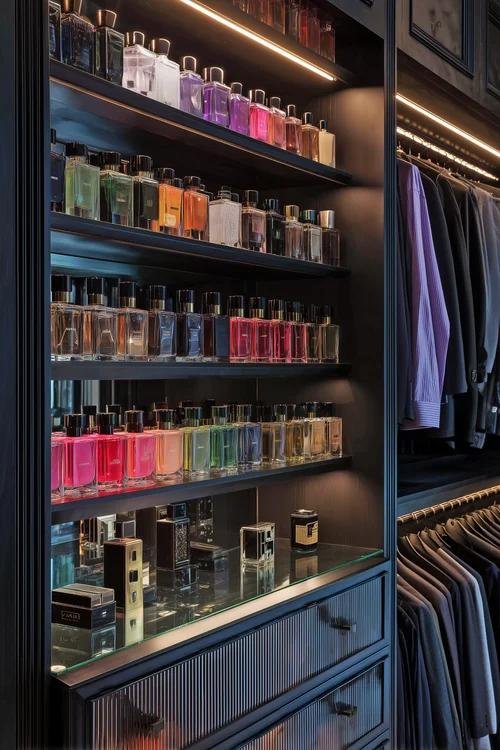
Good perfume storage is surprisingly simple and here are ways to store cologne to make it last longer:
- Keep it away from sunlight: Avoid windowsills and places where direct sunlight reaches the bottle.
- Keep it away from heat: Do not store perfume in a car, beside a generator, close to a cooker or next to another strong heat source.
- Keep the bottle closed: Replace the cap properly after use and make sure the atomizer is not leaking.
- Choose a stable location: A wardrobe, drawer or cupboard is usually better than a place that becomes very hot during the day and cool at night.
- Keep the original box: The box can provide additional protection from light.
- Store the bottle upright: Keeping the bottle upright is a sensible way to reduce the chance of leakage around the cap or atomizer.
- Do not make the bathroom your perfume cabinet: A drawer or wardrobe is generally a better long-term option.
How hot climate can affect perfume storage
If you live in an extremely hot environment, storage deserves extra attention.
Nigeria for instance has a generally warm climate, although conditions vary considerably between regions and seasons.
That does not mean perfume automatically expires quickly in Nigeria.
It simply means you should pay attention to where you keep it.
A bottle sitting in direct sunlight inside a hot room is experiencing very different conditions from one stored inside a dark wardrobe.
Transportation matters too.
If you buy a perfume and leave it inside a vehicle for several hours in the heat, you are exposing it to conditions that are not ideal for long-term storage.
Practical perfume storage tips for Nigeria
If you live in a warm environment:
- Keep perfume inside a wardrobe or drawer.
- Avoid direct sunlight.
- Do not leave bottles in your car.
- Keep fragrances away from generators and cooking areas.
- Keep the cap properly closed.
- Avoid repeatedly moving bottles between extreme temperatures.
- Keep expensive or rarely used fragrances in their original boxes.
You do not need an expensive perfume refrigerator to take good care of your collection.
For most people, a dark and stable storage location is the better solution.
Does the fragrance family affect how long perfume lasts?
It can affect how a fragrance develops, but it cannot give you an exact expiration date.
Perfume formulas contain materials with different levels of volatility and stability.
Citrus notes such as lemon, bergamot and grapefruit are often prominent in the opening. Woody, musky, amber and resinous materials can play a bigger role later in the fragrance.
But there is an important distinction:
How long a note lasts on your skin is not the same as how long the perfume remains stable inside the bottle.
For example, a citrus note may disappear quickly from your skin because it is volatile. That does not automatically mean the entire citrus fragrance will expire quickly in the bottle.
Likewise, a woody perfume is not guaranteed to survive longer simply because it contains woody notes.
If you want to understand how fragrance notes work, read What Are Notes in Perfume?.
What is a perfume batch code?
Many perfume bottles have a batch or production code.
This can help identify manufacturing information and may sometimes help estimate when a fragrance was produced.
However, a batch code should not automatically be treated as an expiration date.
A production code can tell you something about when a product was made. It does not, by itself, tell you the exact day the fragrance will stop being usable.
When assessing an older perfume, consider the batch information together with:
- Storage history
- Bottle condition
- Liquid appearance
- Smell
- Overall performance
That gives you a much better picture than relying on the batch code alone.
If you are checking whether a perfume is genuine, our guide on how to spot fake perfumes in Nigeria also explains why batch codes should be treated as one part of the authentication process rather than absolute proof.
Does old perfume get stronger with age?
Not necessarily.
You may hear fragrance enthusiasts say that an older bottle has become deeper, smoother or richer.
Some fragrances can change in ways that certain people enjoy.
But aging does not always improve perfume.
The same processes that create desirable changes in some bottles can also lead to oxidation and degradation.
So it is more accurate to say:
Some fragrances change with age, but whether the change is desirable depends on the formula, storage conditions and the person smelling it.
There is no rule that says older perfume is always better.
Can you use old cologne on clothes?
You can apply fragrance to clothing, but an old or noticeably discolored perfume deserves extra caution.
A fragrance that has become darker may leave a mark on some fabrics.
Delicate materials can also react differently to alcohol and fragrance ingredients.
If you are unsure about an old bottle, avoid spraying it directly onto an expensive or delicate garment.
For general guidance on applying perfume to clothing and skin, see our guide on how to apply perfume correctly and where.
What about perfume oils?
Perfume oils should not automatically be treated exactly like alcohol-based sprays.
Their formulas, packaging and exposure to air can be different.
The same basic storage principle still applies:
Protect them from excessive heat, direct light and unnecessary air exposure.
If a perfume oil develops an unusual smell, major color change, separation or another unexpected change, stop using it.
Should you throw away an old perfume?
Not simply because it is old.
Before throwing away a bottle, look at its condition.
It may still be fine if:
- It smells normal.
- It still develops normally.
- The liquid remains clear.
- There is no unusual sediment.
- The bottle is properly sealed.
- It has been stored away from excessive heat and sunlight.
Consider replacing it if:
- It smells significantly different.
- It has developed a strong sour or unpleasant smell.
- It has become unusually cloudy.
- You see unexpected particles or sediment.
- The liquid has undergone a major physical change.
- The bottle or atomizer is badly damaged.
- It causes irritation when used.
The FDA also recommends paying attention to changes in cosmetic color or smell and stopping use when an unexpected reaction occurs.
Old Cologne: Keep or Replace?
Here is a simple way to think about it:
| What you notice | What it probably means |
| Slightly darker but smells normal | Not necessarily a problem |
| Several years old but smells normal | Age alone does not mean it is bad |
| Sour or vinegar-like smell | Possible degradation |
| Cloudy liquid | Possible physical change |
| Particles or sediment | Strong reason to stop and inspect |
| Major change in smell and appearance | Better to replace it |
| Causes redness, itching or burning | Stop using it |
This is why there is no useful rule such as “throw away every perfume after five years.”
The bottle itself tells you more than the number of years.
Frequently asked questions
How long is cologne good for?
Many fragrances remain wearable for several years, and some last much longer when stored properly. There is no single lifespan that applies to every bottle.
Does heat make perfume expire faster?
Prolonged exposure to high temperatures can contribute to changes in cosmetics and fragrance. Keeping perfume away from hot cars and other strong heat sources is a good storage habit.
Should I keep perfume in the box?
Yes. The original box can provide additional protection from light, particularly if you plan to keep the fragrance for many years.
Can old perfume irritate your skin?
It can. A fragrance may also contain ingredients that some people are sensitive or allergic to regardless of its age. If a perfume causes redness, itching or burning, stop using it.
Is a perfume batch code the expiration date?
No. A batch code is generally used for production or manufacturing tracking. It should not automatically be treated as the exact date a fragrance expires.
Does darker perfume mean it has expired?
No. Some perfumes naturally become darker with age. A major color change combined with an unpleasant smell, cloudiness or sediment is more concerning than color change alone.
Final answer: Does cologne expire?
Yes, cologne can eventually deteriorate, but there is no universal age at which every bottle suddenly becomes unusable.
Some fragrances remain enjoyable for many years, especially when they are protected from heat, direct sunlight and unnecessary air exposure. Others can change sooner when they have been stored in poor conditions.
If you have an old bottle, do not judge it by age alone, but by asking questions such as:
Does it still smell like the fragrance you remember?
Does the liquid still look normal?
Has it become cloudy or developed particles?
Has it been protected from excessive heat and sunlight?
If the answers are reassuring, the fragrance may still be perfectly wearable even if it is several years old.
If it smells sour, stale or metallic, looks significantly different, has become cloudy, contains unexpected particles or causes skin irritation, it is better to stop using it.
Join the Conversation