To be honest, my first attempt at creating a homemade perfume smelled so awful that I still can’t explain what it smelled like. It was bad enough to make you want to vomit because of how terrible it turned out.
At the time, I made a lot of mistakes that I shouldn’t have made. The biggest one was not being patient enough. Nonetheless, I learned my lesson, and I don’t want you to go through the same frustrating experience I did.
Before writing this article, I successfully created my very first perfume using essential oils. Unfortunately, I failed to document the process with photos, so please bear with me.
Although this article is quite long, I want you to know that I’ve put a great deal of effort into making sure you get it right on your first attempt—something I didn’t. Throughout this guide, I’ll explain why my first perfume failed, how you can avoid making the same mistakes, and what you can do to create a fragrance that smells premium rather than obviously homemade.
At the core of making a homemade perfume, is simply a blend of essential oils mixed with a carrier such as jojoba oil, perfumer’s alcohol, or even vodka in a pinch. A typical ratio is about 15% to 30% essential oils, with the remaining percentage made up of the carrier. After mixing, you let the perfume rest for at least 48 hours so the fragrance can mature into something pleasant and wearable. It really is that simple, but there’s much more to creating a great perfume than it first appears.
So, keep reading. I’ll walk you through the entire process, share more than a dozen ready-to-use perfume blends, explain how to make your fragrance last longer than an hour, and reveal an important safety tip about citrus oils that many guides conveniently leave out.
Why Essential Oils Behave Differently From Perfume Oils
Commercial perfumes are usually built from a mix of synthetic aroma compounds and natural extracts, engineered to evaporate at controlled rates. Essential oils are different. Each one is a natural mixture of many separate aromatic compounds, and every compound in that mixture evaporates at its own speed. This is why a single essential oil, like lavender or bergamot, can smell noticeably different ten minutes after application compared to two hours later.
Perfumers classify oils into three broad groups based on how quickly they evaporate, sometimes called the fragrance pyramid:
- Top notes evaporate fastest, usually within the first 15 to 30 minutes. Citrus oils like lemon, orange, and bergamot fall here.
- Middle notes form the heart of the scent and typically last a few hours. Lavender, geranium, and rose sit in this range.
- Base notes evaporate slowest, sometimes lasting most of the day, and include heavier oils like sandalwood, patchouli, and vetiver.
Analysis of fragrance formulations backs this up with real numbers. One patent filing on fragrance composition places middle notes in a vapor pressure range of about 0.0008 to 0.08 Torr at 22°C, while base notes sit below 0.0008 Torr, meaning they release their scent far more slowly into the air. This is the actual physical reason a well-built blend evolves over the course of a day instead of fading all at once. If you already know your fragrance notes from choosing commercial perfumes, the same logic applies here, just built by hand instead of in a lab.
A well-balanced blend generally uses a rough ratio of 15 to 25 percent top notes, 30 to 40 percent middle notes, and 30 to 55 percent base notes. This is a starting guideline, not a strict rule, since some oils are strong enough that even a few drops will dominate a blend.
How to Choose Your Perfume Concentration
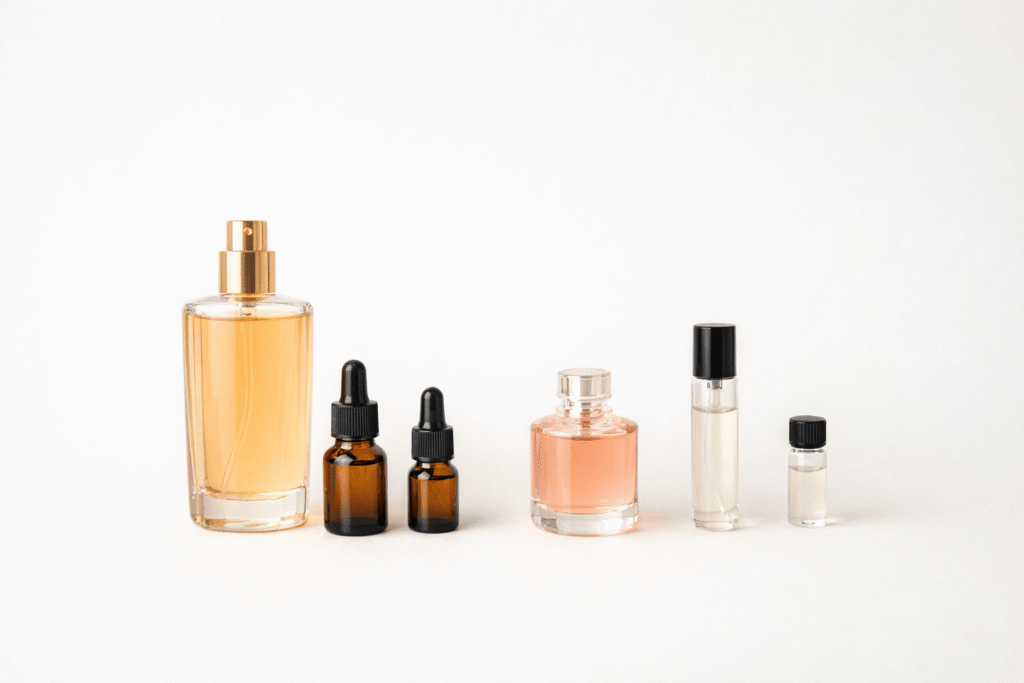
Before you measure anything, decide what kind of product you are actually making, since this changes your entire ratio. The terms perfume, eau de parfum, and cologne all describe the same basic idea (essential oil plus carrier) at different strengths:
| Product type | Essential oil concentration | Best for |
| Perfume (parfum) | 15 to 30% | Strongest, longest-lasting, a little goes a long way |
| Eau de Parfum | 10 to 15% | Good everyday middle ground, close to most store-bought perfumes |
| Eau de Toilette | 4 to 8% | Lighter, more casual daily wear |
| Cologne | 3 to 5% | Very light, subtle |
| Cologne splash or body mist | 1 to 3% | Barely there, good for reapplying often |
For children, and for anyone who is pregnant or nursing, drop the concentration by roughly a third of whatever you were planning, and check each individual oil for its own safety guidance first, since not all essential oils are considered safe for these groups regardless of dilution.
Everything in this guide is written around the 20% perfume-strength range, since that gives the clearest, longest-lasting result for a first attempt. Once you understand the method, scaling down to an eau de toilette or cologne strength is just a smaller drop count for the same size bottle.
What You Need
- Essential oils (top, middle, and base notes, at least one from each group)
- A carrier or base: jojoba oil, fractionated coconut oil, perfumer’s alcohol, or high-proof grain alcohol (see options below)
- A small dark glass bottle, ideally amber or cobalt, since sunlight breaks down aromatic compounds over time. A roller bottle works for oil blends, an atomizer or spray-top bottle works better for alcohol blends
- A glass dropper or pipette for accurate measuring
- A small measuring cup with ml markings and a small funnel, useful once you start measuring alcohol by volume rather than counting drops
- Labels, so you can track what went into each batch
Choosing your alcohol, if you want a spray-style perfume:
- Perfumer’s alcohol is purpose-made for skin and fragrance use, usually denatured ethanol in the 190 to 195 proof range. It is the closest thing to what commercial perfumes use and is worth buying if you plan to make more than one or two batches.
- Everclear (grain alcohol), where legally available, is a strong substitute at up to 190 or 195 proof. It is restricted or unavailable in some states and countries, so check local rules first.
- Vodka works as a budget substitute. Use the highest proof you can find, since more water content means a weaker, less true-smelling result and a shorter shelf life.
- Do not use rubbing alcohol (isopropyl alcohol). It is not meant for skin application in this way and carries a sharp, medicinal smell that will affect your blend permanently.
- Witch hazel is a workable alternative for those who prefer to avoid alcohol entirely, though the final scent will read slightly softer and less projecting than a true alcohol-based perfume.
A quick note on measuring: if you look up a recipe elsewhere and see it written in grams rather than ml, that is not a typo. Essential oils and alcohol are both less dense than water, so a gram measurement and an ml measurement of the same liquid will not match exactly. Either unit works, just do not mix the two systems within a single recipe without converting.
How to Make Perfume with Essential Oils: Step by Step Processes
Before you start, know your conversions. A standard glass dropper delivers about 20 drops per milliliter for thin essential oils, though thicker oils like patchouli or vetiver can run closer to 15 drops per ml. This matters because every recipe below is written in drops, and you need to know roughly how much liquid that translates to so you don’t overfill your bottle.
1. Set up your workspace
Work on a surface you don’t mind staining, essential oils can mark wood and plastic. Lay out your bottle, dropper, carrier, a pack of blotting paper or coffee filter strips cut into thin strips (these work as makeshift scent strips), and a pen to label as you go.
2. Decide your bottle size and total oil percentage first
For a 10ml bottle at a 20% essential oil concentration, which is a good strength for a wearable eau de parfum style blend, you need 2ml of total essential oil and 8ml of carrier. At 20 drops per ml, that is 40 drops of essential oil combined, split across your top, middle, and base notes.
3. Work out your drop split before you touch the bottle
Using the 15/35/50 top/middle/base ratio as a working default: 40 total drops means roughly 6 drops of top notes, 14 drops of middle notes, and 20 drops of base notes. Write this down on paper first. Guessing as you go is how blends end up unbalanced.
4. Add base notes into the empty bottle first
Base notes are thick and slow to evaporate, so they anchor the blend. Using your dropper, count the drops directly into the bottle, one oil at a time. If your base note split is 20 drops across two oils, for example 12 drops sandalwood and 8 drops patchouli, add the sandalwood fully, then the patchouli.
5. Add middle notes next
Same method, one oil at a time, counting drops directly. Middle notes make up the largest share of most blends and do the most work in defining what the perfume actually smells like once it settles.
6. Add top notes last, before the carrier
Top notes are the lightest and most volatile, so they go in last among the essential oils. This order (base, then middle, then top) mirrors how the blend will actually reveal itself on skin, heaviest and longest-lasting first.
7. Cap the bottle and roll it gently between your palms for 15 to 20 seconds
Do not shake hard or invert the bottle repeatedly, this introduces air bubbles and can cause some oils to separate slightly. A gentle roll is enough to combine the drops.
8. Test on a paper strip, not your skin, at this stage
Dip a strip into the mix or dab a drop from the dropper onto it. The smell right now will be sharp and slightly unpleasant, almost like nail polish remover if you used alcohol as your carrier. This is normal and expected before resting.
9. Now add your carrier to fill the bottle
Slowly pour or dropper in the remaining carrier (8ml in this example) until the bottle is full, leaving a small air gap at the top. Cap tightly.
10. Label immediately
Write the date and the exact drop counts of every oil you used directly on the bottle or on a piece of tape. You will not remember the ratio a month from now, and if you want to repeat or adjust a blend later, this record is the only way to do it accurately.
11. Store it somewhere dark and let it rest
This step is very important. It is also where I made the biggest mistake. Put the bottle in a cupboard or drawer, away from sunlight and heat, for a minimum of 48 hours. Two to four weeks gives a noticeably better result, since this is when the raw, sharp smell fully mellows into the actual finished scent.
12. Shake or roll the bottle once a day during resting
This is a small step most guides skip. A daily roll for the first week helps the oils and carrier integrate more evenly, rather than settling into layers.
13. Test on skin only after resting is complete
Apply a small dab to your wrist or inner elbow. Wait 15 minutes before judging it, since your skin’s warmth changes how the top notes present compared to how they smelled on paper. If it is too sharp or unbalanced, you can add a few more drops of your fixative (see the fixative table below) and let it rest again for another few days before testing once more.
Three Starter Blends
Each of these is written for a 10ml bottle at a 20% essential oil concentration, meaning 40 total drops of essential oil (at roughly 20 drops per ml) topped up with 8ml of carrier. Follow the drop order from the steps above: base notes first, then middle, then top.
Citrus and Fresh
- Base: 12 drops sandalwood
- Middle: 12 drops lavender
- Top: 10 drops sweet orange, 6 drops bergamot
- Carrier: 8ml jojoba oil or perfumer’s alcohol
Floral
- Base: 10 drops vetiver
- Middle: 14 drops geranium, 8 drops rose or ylang ylang
- Top: 8 drops bergamot
- Carrier: 8ml jojoba oil or perfumer’s alcohol
Warm and Woody
- Base: 14 drops patchouli, 6 drops vanilla oleoresin
- Middle: 12 drops cedarwood
- Top: 8 drops black pepper
- Carrier: 8ml jojoba oil or perfumer’s alcohol
These ratios are a starting point. Once you understand how each oil behaves, adjust freely based on your own preference. If a blend feels too sharp after resting, add 2 to 3 more drops of your base note and let it rest again for a few days.
Some More Blends to Try
Once you’re comfortable with the full method above, these quick combinations are a fast way to experiment. Each is written for a 10ml roller bottle at a light, everyday-wear dilution (around 3 percent). Add the listed drops into an empty bottle, then top up the rest with your carrier oil of choice:
- Palmarosa (8), geranium (1), ylang ylang (1)
- Lavender (5), sweet orange (4), ylang ylang (1)
- Lavender (6), vetiver (2), lemon (2)
- Rose (5), lime (3), vetiver (2)
- Sandalwood (6), patchouli (1), sweet orange (2), jasmine (1)
- Lavender (4), mandarin (4), juniper (2)
- Bergamot (4), geranium (4), vetiver (2)
- Frankincense (4), sweet orange (4), geranium (2)
- Sandalwood (4), grapefruit (5), ylang ylang (1)
- Cedarwood (5), lavender (3), chamomile (2)
If it helps to think in terms of aroma family rather than top, middle, and base while you’re starting out, these are the groupings most of the combinations above pull from:
- Earthy: patchouli, vetiver
- Floral: geranium, lavender, rose, ylang ylang, jasmine
- Woodsy: sandalwood, cedarwood, frankincense
- Citrus: lime, lemon, bergamot, sweet orange, grapefruit, mandarin
For a smaller 2ml sample or gift-size roller, scale down to 2 to 3 total drops of essential oil rather than trying to keep the exact same ratio, since going any higher in that small a volume pushes past a safe dilution rate.
Interestingly, some of these oils do more than smell good. A 2024 study on bergamot essential oil found that inhaling it activated a specific brain circuit linked to reduced anxiety-like behavior in mice, offering a possible explanation for why citrus scents are so widely described as uplifting. Separate research has also linked bergamot oil to improvements in depression-like symptoms in animal studies, tied to its effect on neuron structure in the brain. None of this means a homemade blend is medicine, but it does explain part of why certain scent families are so consistently popular in personal fragrance.
How to Make It Last Longer
Fixatives are the answer to the most common DIY perfume complaint, which is a scent that fades within an hour. A fixative is typically a heavier base note oil or resin that slows the evaporation of the lighter oils around it. Patchouli, sandalwood, benzoin, and myrrh are commonly used natural fixatives. Adding even a small amount anchors the top and middle notes so the scent tapers off gradually instead of disappearing all at once.
| Fixative | Type | Effect | Typical use amount |
| Sandalwood | Woody base | Anchors floral and citrus blends, adds smooth warmth | 5 to 15% of total oil content |
| Patchouli | Earthy base | Strong fixative, works well in woody and warm blends | 5 to 10% of total oil content |
| Benzoin resin | Resinous base | Adds sweetness, slows evaporation of top notes | 3 to 8% of total oil content |
| Myrrh | Resinous base | Deepens warm and oriental blends, long-lasting | 3 to 8% of total oil content |
| Vetiver | Earthy base | Adds smoky depth, very slow to evaporate | 3 to 10% of total oil content |
Resting time affects the final scent just as much as the fixative you choose. Here is roughly what to expect at each stage:
| Resting stage | Timeframe | What happens |
| Initial blend | 0 to 48 hours | Sharp or “green” smell from raw oils and alcohol |
| Early maceration | 3 days to 1 week | Harsh edges soften, blend starts to smooth out |
| Full maceration | 2 to 4 weeks | Oils fully combine, true character of the blend emerges |
| Long-term aging | 1 to 3 months | Deeper, richer development, especially in base-heavy blends |
Storage also matters more than people expect. Heat, light, and air all speed up the breakdown of aromatic compounds, which is why our guide on how to store perfume properly applies just as much to a homemade blend as it does to a bottle from the store. Keep your bottle in a cool, dark place, away from direct sunlight and bathroom humidity.
If you want to understand more broadly what makes any fragrance, homemade or store-bought, last through the day, our guide on how to determine perfume durability and how to make your perfume last all day cover the same fixative and application principles in more detail.
A Safety Note on Citrus Oils
Citrus essential oils like bergamot, lemon, and lime contain compounds called furocoumarins, which can react with UV light on skin and cause photosensitivity, meaning increased risk of burns or dark patches where the oil was applied and then exposed to sunlight. This is well documented in dermatology research. Multiple studies on bergamot oil specifically have confirmed its phototoxic potential when applied to skin before sun exposure, with sensitivity documented in controlled clinical photopatch testing.
This does not mean you should avoid citrus oils. It means you should apply citrus-heavy blends to skin that will not see direct sun for a few hours, or apply them to clothing rather than skin, or look for bergapten-free (also called FCF, furocoumarin-free) bergamot oil, which has had the phototoxic compound removed and is commonly used in commercial perfumery for exactly this reason.


Join the Conversation